
What the Archives Didn’t Keep: Who Gets Remembered in American Culture and Who Gets Lost in Motion
An essay by Leslie Cunningham
History does not disappear evenly. It slips away in names.
American cultural memory is often told as if it is fixed: jazz emerges in New Orleans, matures in Chicago, and is canonized in Harlem. Entertainment history settles into institutions, recordings, theaters, archives, that give the impression of permanence. But some of its most influential architects never worked inside permanence at all. They moved.
They worked in tents, on fairgrounds, in railcars and on segregated midway stages, where performance traveled faster than documentation, and where influence rarely arrived with attribution.
What gets remembered is what could be stabilized. What traveled often became anonymous.
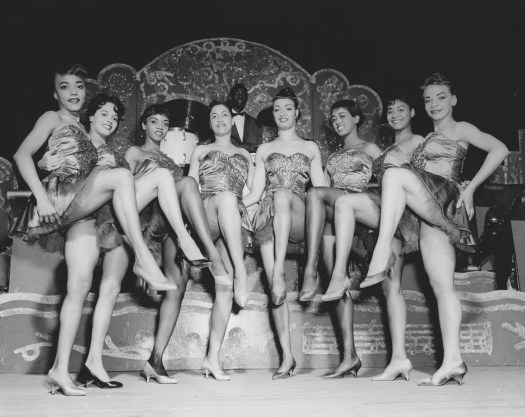
My grandfather, Leon Claxton, built one of the largest Black touring revues in North America under those conditions. His production, Harlem in Havana, moved across the United States and Canada from the 1930s through the 1960s as part of the Royal American Shows circuit. It brought together Black American and Afro-Cuban performers in a highly orchestrated spectacle of music, choreography, comedy and burlesque, playing to thousands of people in towns where such performances were otherwise inaccessible.
It was not marginal entertainment. It was a central engine of popular culture.
And yet today, it exists more as echo than record.
This is not an accident of forgetting. It is a structure of attribution.
The American archive is often treated as neutral, a place where history is preserved as it happened. In practice, it is a system of selection. It determines whose labor is named, whose labor is absorbed into genre and whose labor disappears into generalized categories like “influence” or “tradition.”
Within that system, Black and Afro-Latin performers have often been visible as style but less visible as origin.
Their work is documented as aesthetic effect, not authorship.
Harlem in Havana existed inside this paradox. It was both central and mobile, celebrated and under-recorded. It operated within the vast infrastructure of carnival midways, mobile entertainment cities that carried entire stages, orchestras and performance economies across the country, even as segregation shaped the conditions under which Black performers lived and worked.
Night after night, audiences entered tents to see productions described as unlike anything else on the midway- fully realized shows combining music, choreography and spectacle at a level that helped define the era’s entertainment language.
But when that history was later written, it did not follow the routes of performance. It followed the routes of permanence.
Broadway over the midway. Recording studios over traveling orchestras. Fixed stages over temporary cities.
What happened in transit was harder to cite. What was harder to cite became easier to forget.
The result is a historical imbalance that still shapes how American entertainment is understood. Entire aesthetic lineages exist without being fully connected to their origin points. The influence is visible. The attribution is not.
My entry into this history did not begin in an archive. It began in fragments—photographs without full captions, family stories interrupted by silence, a figure who first appeared as image before becoming biography.
That gap is not incidental. It is evidence of how history was organized.
Because absence of record is not absence of history. It is a record of what was not preserved.
Recovering Harlem in Havana has required working across forms—film, photography, poetry, exhibition, and archival reconstruction, because the history itself was never contained in a single form. It lived across bodies, movement and temporary performance worlds that disappeared as they traveled.
This is the central contradiction: some of the most influential cultural work in American entertainment history was not hidden. It was in motion.
And motion, in archival terms, is instability.
What cannot be stabilized is often not preserved as authorship.
To correct that imbalance requires more than rediscovery. It requires rethinking how cultural memory itself is constructed, not as a fixed sequence of achievements, but as a network of movement, where creativity was produced at scale but documented unevenly.
We are still living inside the results of that system.
The question is not whether Black and Afro-Latin performers shaped American entertainment. The question is why their authorship was not preserved at the same scale as their influence—and what responsibility comes with recognizing that now.
Because history is not only what happened. It is what was allowed to remain legible.
To restore that legibility is not an act of nostalgia. It is an act of precision.
It begins with returning names to motion.
Leslie Cunningham
Written June 2026

